Ledger
No minimum. One entity.
For one entity that wants the record clean before it wants it clever. One rate, all the way up, and a daily payout you do not configure.
Where Ledger stopsThe landing page gives you the number. This page gives you the axes behind it, every capability that changes between plans, and the terms you would be signing. Work out your own rate before you call us.
The board below is the summary you already saw. The table under it is not: it lists everything the platform does, including the rows that rarely decide anything, so nothing is discovered after signature.
No minimum. One entity.
For one entity that wants the record clean before it wants it clever. One rate, all the way up, and a daily payout you do not configure.
Where Ledger stops
From $40k monthly volume.
For groups running more than one scheme, more than one currency or more than one set of books. This is the plan the bands are built for.
See the bands
Committed volume, annual term.
For volume that has outgrown a bracket, and for contracts that name a region, a response time and a person.
Talk to the desk| Capability | Ledger 0.28% + $0.14 | Clearing 0.19% + $0.09 | Enterprise Negotiated |
|---|---|---|---|
| Clearing and disputes01 / 06 | |||
| Payment clearing and disputes | Included | Included | Included |
| Card schemes | Two schemes | Every supported scheme | Schemes plus local rails |
| Bank transfer routes | Domestic | Domestic and cross-border | Dedicated routes on request |
| Wallet capture | Standard set | Standard and regional | Any wallet you contract |
| Reconciliation and the ledger02 / 06 | |||
| Automated reconciliation | Bank files only | Bank, scheme and FX | Bank, scheme, FX and custom sources |
| Entities and sub-accounts | 1 entity | Up to 12 | Unlimited |
| Ledger retention | 24 months | 7 years | 7 years, extendable |
| Break resolution queue | One shared queue | Per entity | Per entity, rules you write |
| Treasury and payouts03 / 06 | |||
| Payout scheduling | Daily | Rule-based, per entity | Rule-based, with treasury sweeps |
| Settlement currencies | 3 | 24 | On request |
| FX handling | Passed through at the scheme rate | Managed, locked daily | Managed, locked for the term |
| Balance sweeps | — | — | Included |
| Reporting and audit04 / 06 | |||
| Audit reports and evidence pack | On request | Included | Included |
| Reporting API | Read only | Read and export | Read, export and scheduled delivery |
| Data residency choice | — | EU or US | EU, US, APAC or dedicated |
| Change log and processor register | Published | Published, with alerts | Published, with alerts and a review call |
| Environments and access05 / 06 | |||
| Sandbox environments | 1 | 3 | Unlimited |
| Role-based access | Fixed roles | Custom roles | Custom roles and single sign-on |
| Approval rules | — | Two-person on payouts | Two-person, configurable per action |
| Access log retention | 90 days | 12 months | 12 months, exportable |
| Support and terms06 / 06 | |||
| Support response | Next business day | 4 hours | 1 hour, named engineer |
| Implementation | Self-serve | Guided, six weeks | Guided, scoped per entity |
| Minimum term | None | 12 months | 12 months, committed volume |
| Uptime commitment | Best effort | 99.9%, credited | 99.95%, credited |
24 rows · 3 plans · sample values throughout
Volume is the one everyone asks about first, and the only one with brackets. The other three move the rate in smaller steps, and they are the ones that surprise people in the third month.
| Monthly settled volume | Ledger | Clearing | Enterprise |
|---|---|---|---|
| Up to $250k | 0.28% + $0.14 | 0.24% + $0.11 | — |
| $250k to $2M | 0.28% + $0.14 | 0.19% + $0.09 | — |
| $2M to $10M | Plan ceiling | 0.16% + $0.08 | Quoted |
| $10M to $50M | Plan ceiling | 0.14% + $0.07 | Quoted |
| Above $50M | Plan ceiling | Quoted | Quoted |
The rate on the landing page is the middle band. Ledger holds one rate the whole way up, which is where the plan stops rather than a penalty: past two million a month the reconciliation work changes shape and so does the plan.
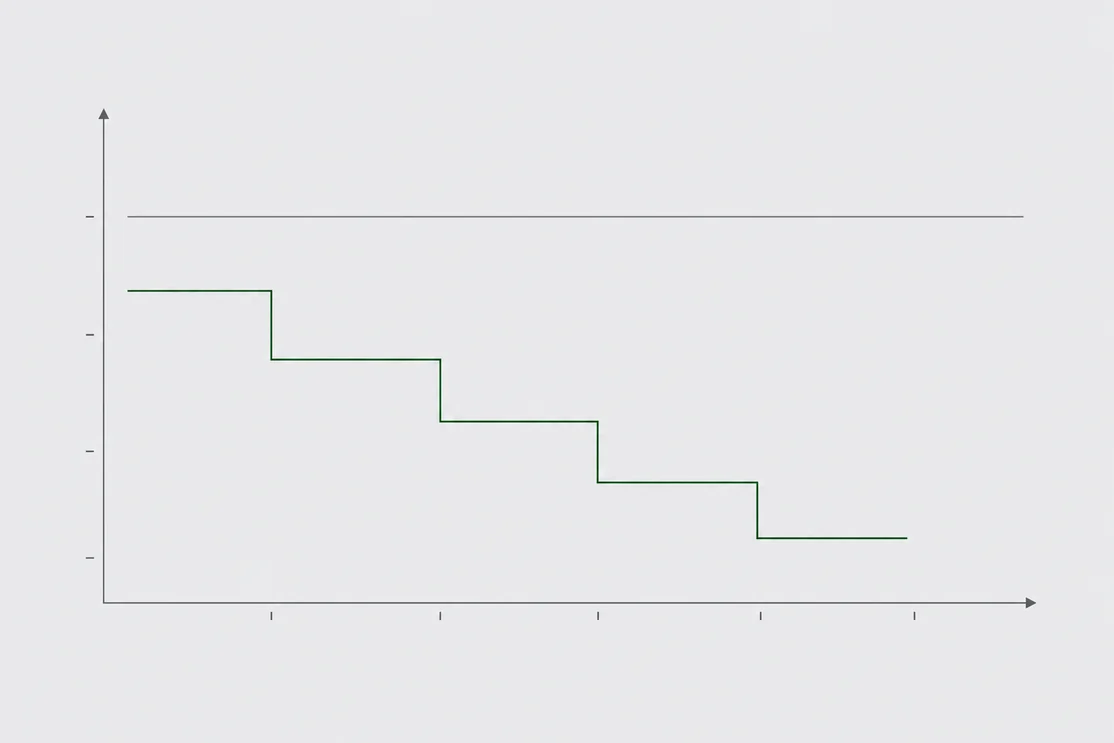
A payment settled in the currency it was taken in costs the band rate and nothing else. Convert it and the conversion is priced on its own line: Clearing locks a rate for the day, Enterprise locks one for the term, and Ledger passes the scheme rate through without touching it.
A daily payout is the cheapest thing here because the money is never held. Rules hold balances for exactly as long as you say, and holding costs something to guarantee. Treasury sweeps hold the least and cost the most to operate, which is why they sit on one plan and not three.
Cross a band in the middle of a month and the new rate applies to the volume above the line, not to the month behind it. Nothing is rebilled backwards. Scheme and interchange costs sit outside all of this and arrive at cost, itemised against the settlement they belong to.
Four numbers decide most of it. The questions underneath are the ones that come back from procurement, so they are answered here rather than on a call.
Ledger has none and can be closed the month you open it. Clearing and Enterprise run an annual term, billed monthly.
Written notice, at any point in the term. What is left of a committed year stays payable, and nothing renews without a signature.
Measured on authorization availability across a calendar month. Miss it and the month is credited against a published scale.
After termination the full ledger stays exportable in the reporting format. Then it is destroyed and a certificate is issued.
Upward, on the first of any month, and the term restarts from that date. Downward at renewal only, because the lower plan cannot hold the entities and sources the higher one opened. We will tell you which of those you are actually using before you decide.
The lower rate applies to the volume above the line from the moment it is crossed. The volume below it keeps the rate it was settled at. One invoice, two rates on it, and the crossing point named on the line so you can check the arithmetic against your own numbers.
On Clearing and Enterprise it is quoted once, before the contract, and it does not move after signature. Ledger has no implementation fee because it has no implementation: you connect it yourself and the documentation is the whole of the help you get.
Credits run on a published scale against the month's platform fee, applied to the next invoice without you asking. They are calculated from our own incident record, which is the same record you can read. Credits are the remedy; they are not a cap on anything else in the contract.
Published rates can change with sixty days of notice and the new ones apply from your next term, never inside one you have already signed. Negotiated rates hold for the term as written. Pass-through costs are the exception and always have been: those move when the schemes move them.
Negotiated is not a hidden tier. It is what happens when a month of real settlement files prices better than a bracket does. Send the files and the rails, and we price against those.
You get a rate against your own files within two working days, in one document, whether or not the conversation goes further. If the answer is that Clearing already prices better for you, that is the answer we send.