

REST API
Payments, ledger entries and settlement records, versioned by date and never broken in place.
POST /v1/connectors/:id/instructionsSix categories of connector, maintained the way the rest of the platform is: versioned, monitored, and covered by the same change log. When a partner moves a field, the log says so before your job fails on it.
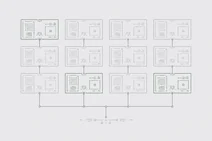
Nothing here is a partnership announcement. Each entry is a maintained connector with an owner, a version and a monitor on it. Point at one to see what it carries.
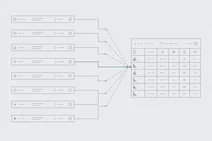
Domestic and cross-border rails. Every one of them lands as the same shape of record.
Acquiring routes and scheme services. Reason codes survive the whole trip.
Methods that exist in one market only, held to the same reconciliation rules as the rest.
Journals leave in the shape your finance team already agreed on with the auditor.
Smaller books, same double entry. The sync runs on your close calendar, not ours.
Raw ledger movements land in your warehouse, not a rolled-up copy of them.
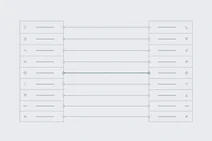
A connector that is not on this list is not a refusal. Anything that speaks a file, an API or a message queue can be written against the same interface the maintained ones use, and it reconciles identically.
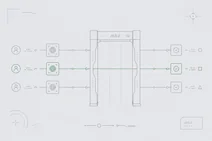
Nobody sits in the middle of this. You issue your own keys, run against a sandbox that returns the failures as well as the happy path, and ask for the switch once your reconciliation agrees with your existing books.
Create a key pair in the console, scoped to one connector and one environment. Rotation is yours to run whenever you like, and support never needs to see a key to help you.
Scoped per connectorThe sandbox answers with the same message shapes production does, failures included. Decline codes, half-written files and a statement that arrives a day late are all reproducible on demand.
Replays production shapesRun a month of your own history through it, then read the difference against the books you already closed. We go through the breaks with you rather than sending a report about them.
Usually 3 to 5 working daysTraffic moves on a date you pick, one connector at a time. The route you were using stays open until you close it, so a rollback is a configuration change rather than an incident.
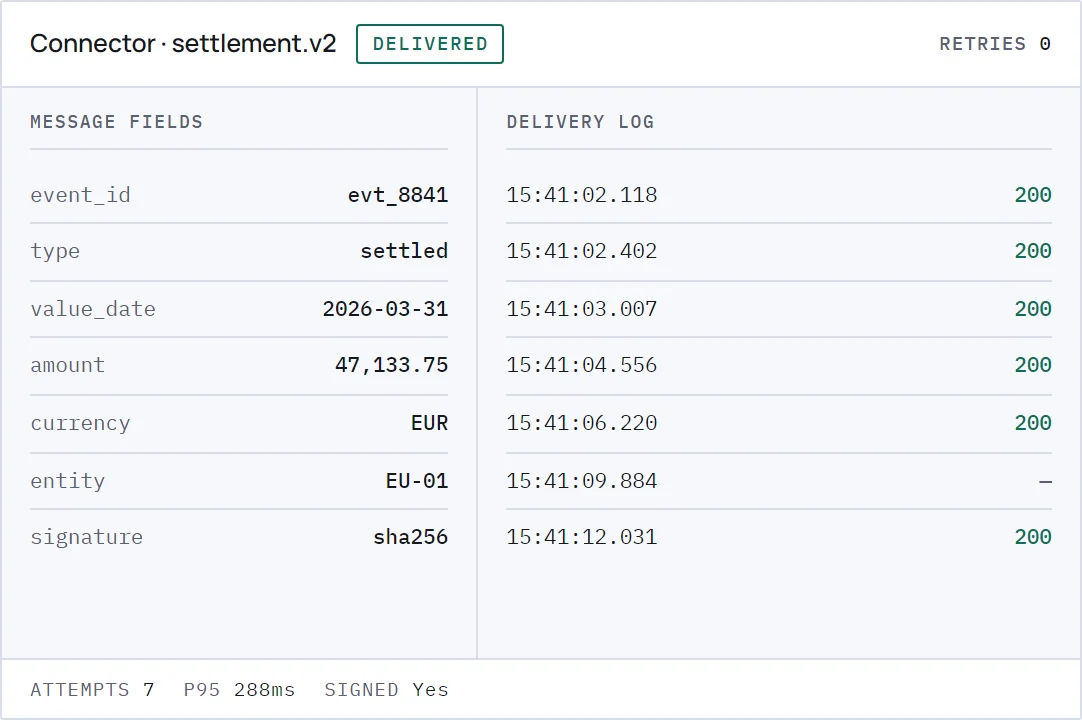
Rollback open for 30 daysEvery connector in the catalogue is documented to this depth. This one is reproduced here so you can judge that depth without asking for access first.
| Capability | What it does | Guarantee |
|---|---|---|
| Webhooks | Status changes are pushed as they happen, with the payment reference and the raw response attached. | At least once, signed |
| Settlement files | The bank file that closes the day is stored beside the entries it settles, in the format it arrived in. | Kept 7 years |
| Retries | A failed delivery backs off and retries on its own schedule; nothing is dropped without an entry saying so. | Backoff to 24 h |
| Idempotency keys | Send the same instruction twice and the second one returns the first result rather than a second payment. | 72 h window |
| Reconciliation reference | One identifier follows the amount from the instruction to the statement line that clears it. | End to end |
| Version pinning | A connector version stays available after a new one ships, so an upgrade is scheduled rather than forced. | 12 months notice |
None of the maintained connectors uses a private route. If the system you run is not in the catalogue, you write it against the interface below and it reconciles the same way everything else does.
Payments, ledger entries and settlement records, versioned by date and never broken in place.
POST /v1/connectors/:id/instructionsSigned events for every state change, replayable from the console for the last thirty days.
connector.instruction.settledThin clients over the same endpoints, with the retry and idempotency rules already wired in.
tessen.connectors.settle(ref)A full environment per key, seeded with your own file formats and the failures you want to test.
sk_sandbox_… scoped per connector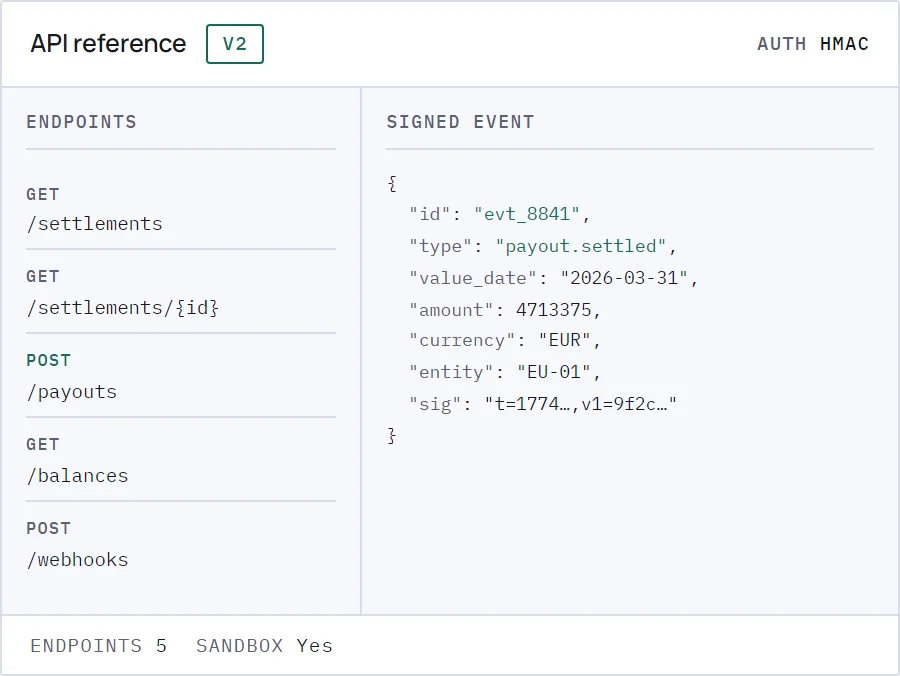
The connector guide covers the message contract, the retry rules and the reconciliation reference in full. Read it before you talk to us; most of the questions on the first call are answered in it.
Read the connector guideWe will tell you which connectors already cover them, which need a build and roughly what that build costs. It comes back as a list, not a proposal.